CADETS CORNER
Made a mistake? Own it. Report it. Immediately.
The team cannot respond to a problem it does not know exists. Your honesty gives us something valuable: time to act.
There is a particular moment every cadet hopes to avoid. You look at what you have just done and think: “That was not right.”
Your stomach drops. Your brain suddenly becomes a highly efficient excuse factory. Three explanations are ready before you have said a single useful word.
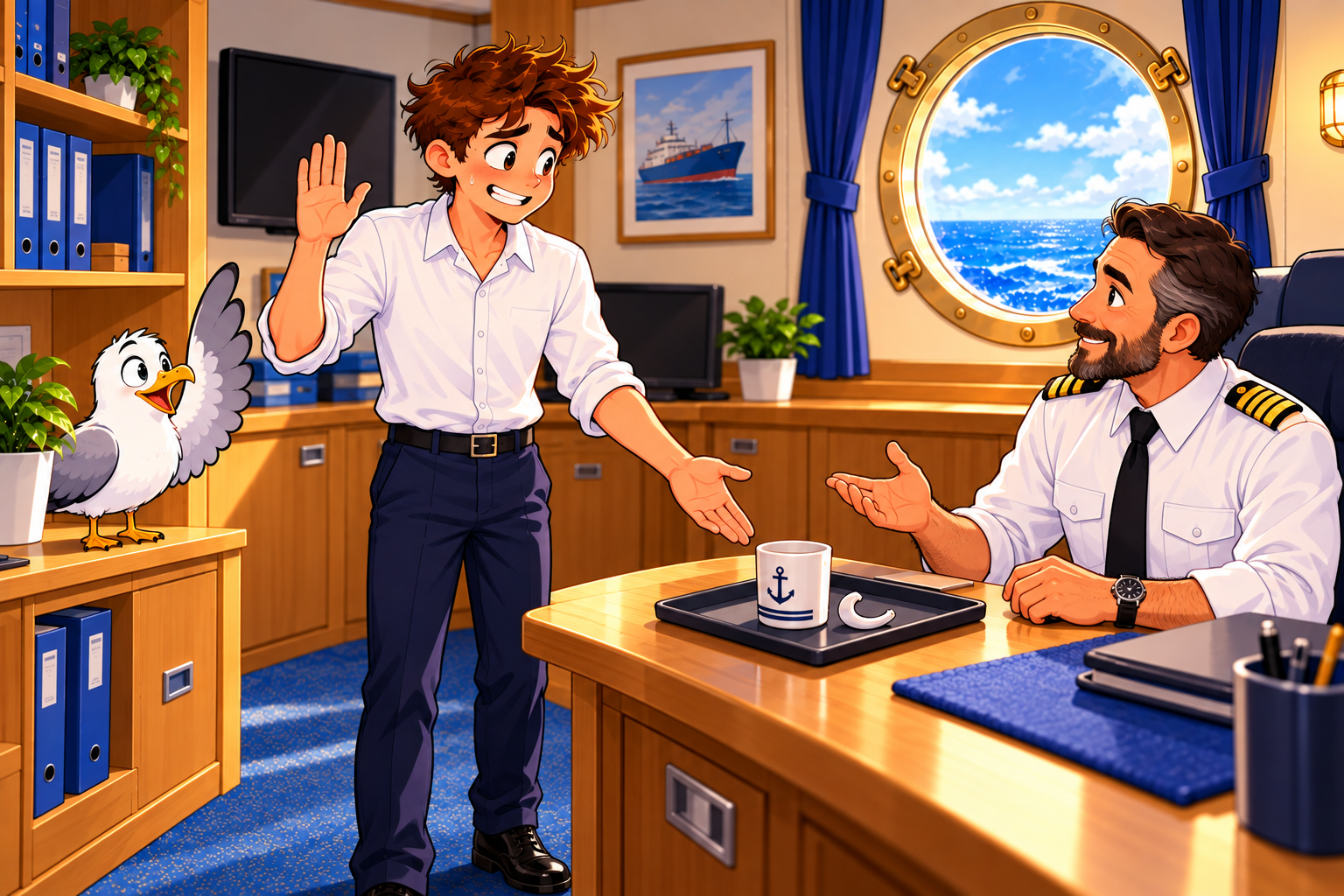
Take a breath. What matters now is not how convincingly you can look innocent. It is owning your mistake and immediately telling the right person what happened.
Putting your hand up means admitting it: “I made a mistake.” The important part is taking responsibility, not making a gesture. Do not hide your involvement behind “something went wrong” when you know what you did. Be honest about your action, and equally honest about anything you are still unsure of.
This guide is for deck cadets, engine cadets and anyone learning how to report a mistake onboard a ship. It focuses on merchant ships, but the principle travels well: an early, honest report gives the team a better chance to respond.
SPEAK UP. GIVE THE TEAM TIME.
Made a mistake? Admit it immediately and tell the responsible officer what you did. Give the team the earliest possible chance to put it right and protect the ship.
The principle is simple: own the mistake and report it now. Not only if someone notices. Not after trying three secret solutions. Admitting your part gives the team information it needs to respond.
1. Modern systems are impressive. The people onboard still matter.
On a modern LNG carrier, for example, sophisticated automation can monitor and control many processes. Connected systems can also give shore specialists valuable diagnostic information and support.
But remote support is not the same thing as permission or capability to run every ship’s cargo operation from an office anywhere in the world. The arrangements depend on the particular vessel, approved systems and procedures.
The point is not that technology makes the crew unnecessary. It is that technology does not remove the need for people who understand what is happening and can respond on the spot.
You are there to operate safely, observe, communicate and act within your role — during normal operations and when something unexpected happens. A shore specialist may help interpret data. The team onboard must still assess the actual situation and take the appropriate local action.
Your job is not simply to watch a screen look reassuring. It is to help the team understand reality.
2. The sooner we know, the sooner we can respond
A wrong entry, damaged equipment or an unintended action may have consequences beyond what you can see. Other people may be relying on that information or assuming equipment is in the expected condition.
If you report promptly, the responsible team can assess the situation, protect people and decide what action is needed. If you stay silent, the next decision may be made on a false assumption.
Early reporting does not guarantee that every consequence can be prevented. But a delay can take away options the team might otherwise have had.
Protecting the ship means protecting people, the environment and safe operations. It does not mean hiding an incident to protect appearances. Honest reporting is part of protecting the ship — not an embarrassment to be avoided.
3. Do not turn one mistake into a secret repair project
The temptation is understandable: “I will just put it back before anyone sees.” But you may not understand the full effect of the original action, or what a second action could change.
- Do not keep repeating an action you believe may be unsafe.
- Do not experiment with controls, valves, settings or equipment to hide what happened.
- Do not delete messages, conceal damage, backdate entries or overwrite records to remove the evidence.
- Do not ask a friend to help you keep it quiet.
Raise the concern immediately with the responsible officer. Take any immediate protective action required by your training and the vessel’s procedures, without putting yourself or others at risk. If there is immediate danger, use the ship’s emergency reporting and alarm arrangements; do not wait to prepare an explanation.
This is not advice to freeze or wait passively in an emergency. It is advice against unauthorised improvisation and concealment.
You do not need to become the secret maintenance department before dinner.
4. “I made a mistake.” Then explain the facts.
If you know you made the mistake, say so clearly and explain what you did. An apology alone does not tell the team what needs attention. Your first report does not need perfect grammar, a diagnosis or a polished incident report.
Useful information includes:
- What: what you did or observed.
- Where: the exact location, document or equipment, as far as you know.
- When: when it happened or when you noticed.
- Now: what you can actually observe and any action already taken.
- Uncertainty: what you do not know.
A simple way to begin:
“Officer, I made a mistake. I did [action] at [location] at approximately [time]. I have observed [facts]. I have already [action taken]. I am not sure about [uncertainty].”
If urgent, lead with the danger and location. If you do not know something, say so. Do not fill a gap with a confident guess.
Make sure the report is received and understood. A safety-critical message left unread on someone’s phone is not enough. If the first contact is unavailable, follow the vessel’s escalation procedure to the appropriate watchkeeper, senior officer or Master.
5. Small examples. Important habits.
You sent the wrong attachment. Inform the responsible person promptly: identify what was sent, to whom and when. Follow instructions for correction and any data-security reporting. Do not assume nobody will open it.
You notice an incorrect figure in a record. Report it and use the approved correction process. Preserve the required audit trail. Making the number look right is not the same as correcting the record properly.
You damaged a tool or piece of equipment. Report the damage before someone else relies on it. Follow the vessel’s arrangements to prevent unsafe use; do not quietly return it to the shelf.
You think you operated the wrong control. Report immediately using the vessel’s procedures. Do not operate it again to “undo” the action unless directed or required by your training and emergency procedures.
These examples are about reporting behaviour, not equipment-specific recovery instructions. The safe response depends on the actual situation.
6. “Nothing happened” is not always the end of it
Sometimes a mistake is caught before it causes harm. Sometimes a barrier works, or a colleague intervenes. That does not automatically make the event unimportant.
The ship’s Safety Management System sets out how accidents, hazardous situations, non-conformities and near misses are reported and followed up. The purpose is to learn, identify contributing factors and reduce the chance of recurrence — not simply collect forms.
An immediate verbal alert and a formal report do different jobs. First get urgent information to the people who need it. Then complete the required records and follow-up honestly. Do not delay an urgent alert while trying to produce a beautiful paragraph.
7. Own your part. Understand the whole situation.
Take responsibility for what you actually did. Do not blame a colleague to make your story easier. Equally, do not invent certainty or accept an inaccurate account just because you are the most junior person in the room.
Unclear instructions, inadequate supervision, confusing labels, fatigue or an unfamiliar procedure may also need examination. Explain those facts honestly. Understanding contributing conditions is not the same as making excuses.
Once the situation is under control, ask what should happen differently next time. If more training is needed, arrange it with your supervisor. Take the lesson into the next task, rather than carrying only the embarrassment.
8. A word to the people receiving the report
When a cadet says, “I made a mistake,” listen. Assess the risk, get the facts and organise the response. There will be time for review after the immediate situation has been dealt with.
Humiliation is not a corrective action. If every early report produces an audience and a shouting match, the next person may hesitate when you most need them to speak.
Fair accountability still matters. Encouraging honest reporting does not mean ignoring deliberate concealment, reckless conduct or repeated disregard of instructions. It means treating people fairly and examining what happened instead of deciding everything from the lowest rank involved.
For the cadet who is worried about the reaction: you should not have to choose between safety and dignity. Still, do not withhold an urgent safety concern. Use the vessel’s reporting and escalation channels, and the company’s designated reporting or support arrangements if your concern is dismissed or you experience retaliation.
The habit that builds trust
You do not build professional trust by pretending you never make mistakes. You build it by being honest about what you know, reporting promptly and following through on what you learn.
Before a task, ask again if the instruction is unclear. During a watch, stay attentive and understand your assigned role. If a mistake happens, tell the team while they still have the earliest possible chance to act.
Keep your career paperwork organised too. Download Wave — The Seafarers’ Digital Wallet to organise your personal certificates and sea-service records, access documents offline and follow your career progress. Wave is your personal maritime wallet, not the vessel’s incident-reporting system. Operational concerns must go through the proper shipboard channels.
Own the mistake.
Report it immediately.
Give the team time to act.
The ship does not need you to look perfect. It needs you to be honest, alert and part of the team.