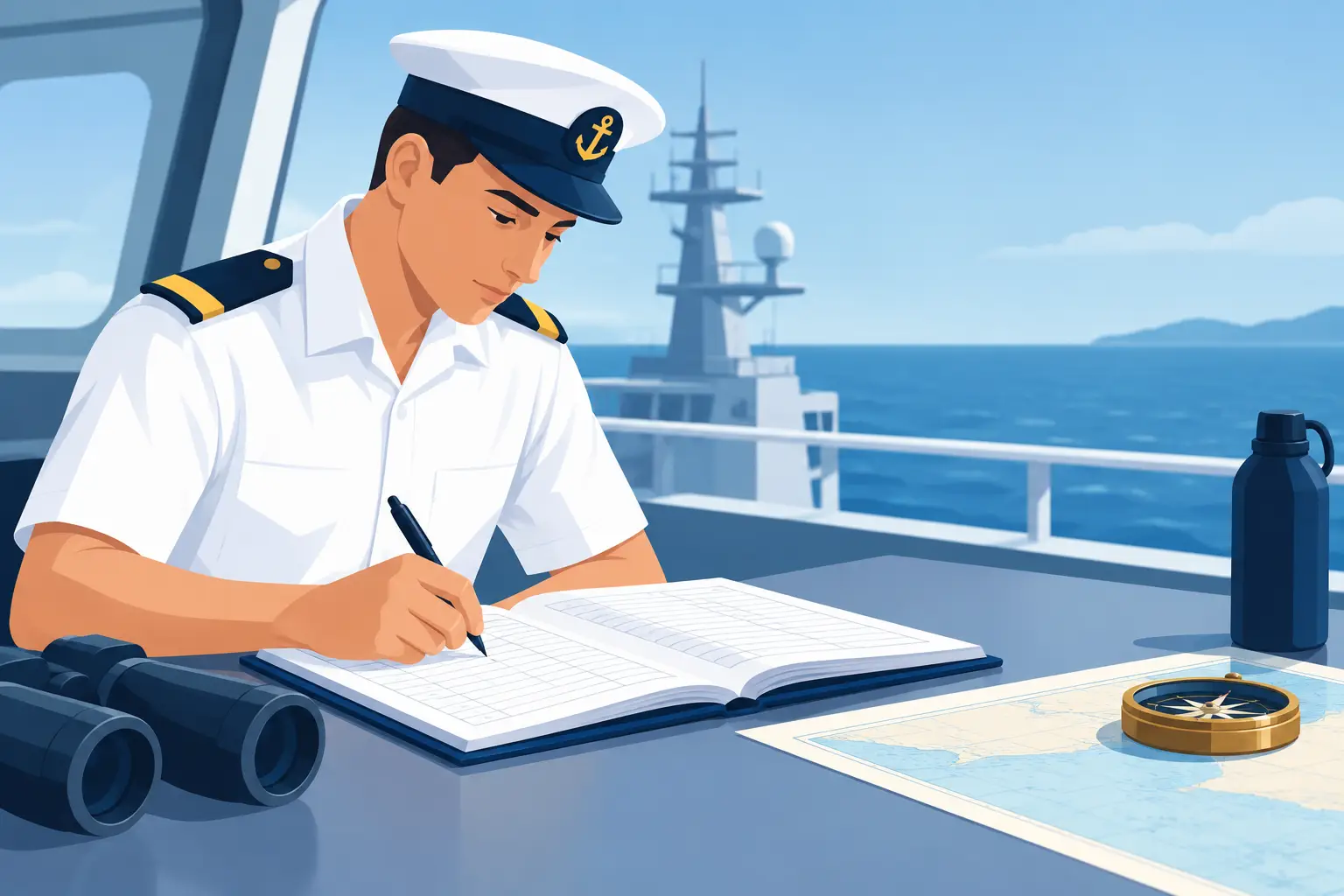
A cadet sea service logbook is more than a record of days onboard. It is part of the evidence supporting your onboard training, competency development, and eventual application for a Certificate of Competency or another professional qualification.
A missing date, an unclear vessel entry, an unsigned task, or a difference between your logbook and official documents can create avoidable delays when your sea time is assessed.
The work begins before you sail. Set up your logbook carefully, keep it current throughout the voyage, and review it before signing off while the people who can verify your service are still available. That discipline protects the sea time you have completed and gives your next application a clearer path.
What a Cadet Sea Service Logbook Proves
A cadet sea service logbook documents the practical part of maritime training that cannot be demonstrated by a classroom certificate alone.
Depending on your training programme, flag administration, academy, company, or licensing authority, it may record:
- vessels served on
- exact dates of service
- rank or trainee designation
- bridge or engine-room watchkeeping exposure
- onboard duties
- completed training tasks
- practical assessments
- supervising officers’ names and signatures
- progress toward required competencies
It also gives an assessor important context. Recording only vessel names and dates may show that you spent time at sea, but it may not demonstrate the range of experience gained during that time.
A properly maintained Training Record Book, or TRB, shows where the training took place, which tasks were completed, who supervised them, and how the cadet progressed from observation to supervised participation and demonstrated competence.
Requirements are not identical worldwide. Some programmes use an approved Training Record Book containing prescribed tasks, assessments, and signature pages. Others require additional proof of sea service, company testimonials, watchkeeping records, or supporting training portfolios.
Always follow the instructions issued by your academy, employer, flag administration, and licensing authority. A personal digital record can support your preparation, but it does not replace an official Training Record Book or formally accepted proof of sea service.
Set Up Your Logbook Before Joining
Do not wait until the first port call to gather the vessel’s basic information. The first days onboard can be busy, and information that initially appears easy to find may become more difficult to confirm after a crew change or several months at sea.
Record the vessel’s official name, IMO number, flag, vessel type, operator or company name, and your joining date. Include gross tonnage, propulsion details, engine power, trading area, or other technical information when required by your training programme.
Confirm that your trainee designation is recorded correctly. Deck cadet, engine cadet, electro-technical cadet, and other trainee positions may follow different training requirements and competency pathways.
You should also identify the officers responsible for supervising and verifying your training. Know:
- who can sign individual task entries
- who reviews your Training Record Book
- who maintains official crew or discharge records
- who should confirm your final dates of service
- which company representative can issue a sea-service testimonial
This does not mean chasing every signature on your first day. It means understanding the verification process before you need to use it.
Keep clear copies of your joining letter, employment agreement, discharge book or Seaman’s Book entries, crew documentation, and any company-issued sea-service testimonial. Your cadet sea-time record should agree with those supporting documents.
If dates, ranks, or vessel details differ, investigate the difference early instead of assuming that it will be accepted during a future application.
Record Sea Time as It Happens
The safest approach is simple: make entries while the details are still fresh.
A short and accurate update every week is more reliable than attempting to reconstruct six months of service from memory after signing off.
For each service period, record the joining and leaving dates exactly as they appear in the official records. Note the vessel, position, department, and nature of the work completed.
If your programme distinguishes between underway time, time in port, maintenance periods, watchkeeping duties, supervised tasks, and operational training, use those categories consistently.
Be precise without turning every entry into a personal diary.
“Assisted with cargo watch” provides limited information. A more useful entry could explain that you completed supervised cargo-watch rounds, checked tank levels, recorded manifold pressures, and reported abnormal conditions to the officer of the watch.
The same principle applies to an engine cadet logbook. Identify the machinery involved, the maintenance or operational activity, the relevant safety controls, and the level of supervision.
Use the terminology required by your approved Training Record Book. Your description should be factual, concise, and detailed enough for a supervisor or assessor to understand what you actually did.
A practical routine is to update personal notes after meaningful training activities and then transfer the confirmed information to the official logbook at regular intervals.
If an officer’s signature is required after each task, choose an appropriate time to request it. Do not interrupt a manoeuvre, emergency response, cargo operation, or other safety-critical activity to obtain a signature.
Separate Observation, Experience, and Competence
Watching a task being performed is valuable, but it is not the same as participating in the task or demonstrating competence.
Your logbook should reflect this difference honestly.
For example, you may observe enclosed-space entry preparations several times before participating under supervision. You may assist with a maintenance task before you can independently explain the isolation procedure, risk controls, permits, and safety checks.
Record the level of involvement required by your training programme, and do not request a competency sign-off until you have met the stated standard.
Accurate entries protect you as well as the assessor. Overstating experience can create problems during an oral examination, application review, audit, or onboard interview.
A cadet who can clearly explain the training recorded in the logbook creates more confidence than one whose record contains broad or unsupported claims.
Get Signatures and Assessments Before Signing Off
The final week onboard is a poor time to discover that several months of entries still require review.
Masters, chief engineers, training officers, and department heads have operational responsibilities. Crew changes, leave arrangements, and vessel schedules can make it difficult to obtain missing verification at the last moment.
Build verification into the voyage. Review completed sections with your supervisor at reasonable intervals, particularly after:
- a watchkeeping period
- completion of an important training section
- a dry-dock or maintenance period
- a long passage
- a change of supervising officer
- a change of Master or Chief Engineer
If an entry needs clarification or correction, it is easier to resolve while the equipment, operation, documents, and people involved are still available.
Before leaving the vessel, check that all required signatures, printed names, ranks, dates, vessel stamps, assessments, and company endorsements are present and readable.
A signature without a printed name, rank, or date may be difficult to verify later. Blank assessment pages, overwritten dates, incomplete vessel details, and unexplained corrections may also lead to questions.
If you make an error, correct it according to the rules of your Training Record Book or training programme. Do not erase or obscure information in a way that makes the record appear altered.
A clear correction that is dated and initialled, where required, is normally better than an entry that appears to have been rewritten without explanation.
Connect Your Logbook With Supporting Sea-Service Records
Your Training Record Book records your practical development, but it is usually not the only document required when your sea time is assessed.
Supporting evidence may include:
- Seaman’s Book or discharge book entries
- company sea-service testimonials
- contracts or employment letters
- watchkeeping certificates
- vessel particulars
- joining and sign-off records
- copies of completed assessment pages
- academy or company training reports
The names, dates, positions, and vessel details across these documents should be consistent.
Keep each vessel entry accurate and update your personal sea-service history after every contract. Recording the information immediately is much easier than reconstructing it several years later from emails, contracts, and handwritten notes.
For guidance on preparing a clear and portable summary of your vessel history, read How to Export Sea Service Records as PDF Files.
Remember that a personal calculation of total sea time is a planning tool. The relevant maritime administration, academy, employer, or licensing authority decides whether particular service qualifies for a certificate or professional application.
Keep a Personal Digital Backup
The official cadet Training Record Book remains the controlling document when it is required by an academy or authority. However, maintaining a private digital backup of your vessel history and completed records is good professional practice.
A searchable personal record can help when you need to:
- update your CV or résumé
- confirm previous joining and leaving dates
- calculate your accumulated sea time
- prepare a company application
- review completed training
- locate a sea-service testimonial
- support a future Certificate of Competency application
Store clear scans or photographs of completed pages, discharge documents, certificates, assessments, and vessel records in a private and organized location.
Use consistent file names. A format containing the vessel name, IMO number, document type, and service dates is more useful than a file called “IMG_4821.”
Where a document has several pages or information on both sides, make sure the complete record is captured. Check that names, signatures, stamps, dates, and certificate numbers remain readable.
An offline maritime document wallet can help keep personal records accessible when internet connectivity is limited or unavailable.
Offline access is particularly useful onboard, where satellite connectivity may be restricted, slow, expensive, or temporarily unavailable. Keep essential records accessible on your device and allow updates to synchronize when connectivity returns.
Protect your device with a strong passcode and avoid sending identity documents or personal records through unsecured channels.
A digital backup supports your professional organization. It does not replace original documents, official signatures, company-issued testimonials, or authority verification.
Common Cadet Logbook Problems That Delay Applications
Many application delays are caused by small administrative gaps rather than a lack of sea time or training.
Common problems include:
- incomplete joining or leaving dates
- vessel details that do not match official documents
- missing IMO numbers
- incorrect trainee designations
- unsigned task or assessment pages
- missing supervisor names or ranks
- unreadable signatures or stamps
- sea service recorded only as total months instead of exact dates
- unexplained overlaps between service periods
- missing company testimonials
- damaged or incomplete scanned copies
- tasks signed without enough supporting detail
Another common problem is treating the logbook as a final administrative task. By then, the officer who supervised a task may have signed off, the vessel may be operating in another part of the world, and the details of a particular operation may no longer be easy to confirm.
Regular updates reduce this risk.
There is also a balance between too little and too much detail. Entries that are too brief can make the training difficult to assess, while long informal descriptions can hide the evidence that the assessor actually needs.
Follow the wording and competency structure of your approved Training Record Book. State what happened clearly and add concise operational details where they support the task or competency being recorded.
Review Everything at the End of Each Voyage
Before signing off, compare the complete cadet sea service logbook with your supporting records.
Confirm:
- official vessel name and IMO number
- correct joining and leaving dates
- cadet rank or trainee designation
- completed training tasks
- competency assessments
- supervisor names and ranks
- required signatures and stamps
- company endorsements
- any remaining incomplete sections
After leaving the vessel, update your personal vessel history and securely store copies of the relevant documents while the details are still fresh.
This short routine can prevent months of uncertainty when you later apply for an officer certificate, employment, an endorsement, or additional training.
Make Your Next Contract Easier
A cadet sea service logbook should be a working record of genuine professional development, not a collection of signatures completed at the end of a contract.
Keep it current, keep it accurate, and keep the supporting evidence close.
Wave – The Seafarers’ Digital Wallet helps cadets maintain personal vessel-level sea-service records, certificate copies, expiry dates, training documents, and supporting evidence in one private, offline-first app.
Wave supports your personal career record. It does not replace an official Training Record Book, discharge documentation, company testimonials, original certificates, or the verification requirements of an academy, employer, flag administration, or licensing authority.
Download Wave on iOS or Android.
When the time comes for assessment or application, your sea service and training record should already be ready to show.
Leave a Reply