CADETS CORNER
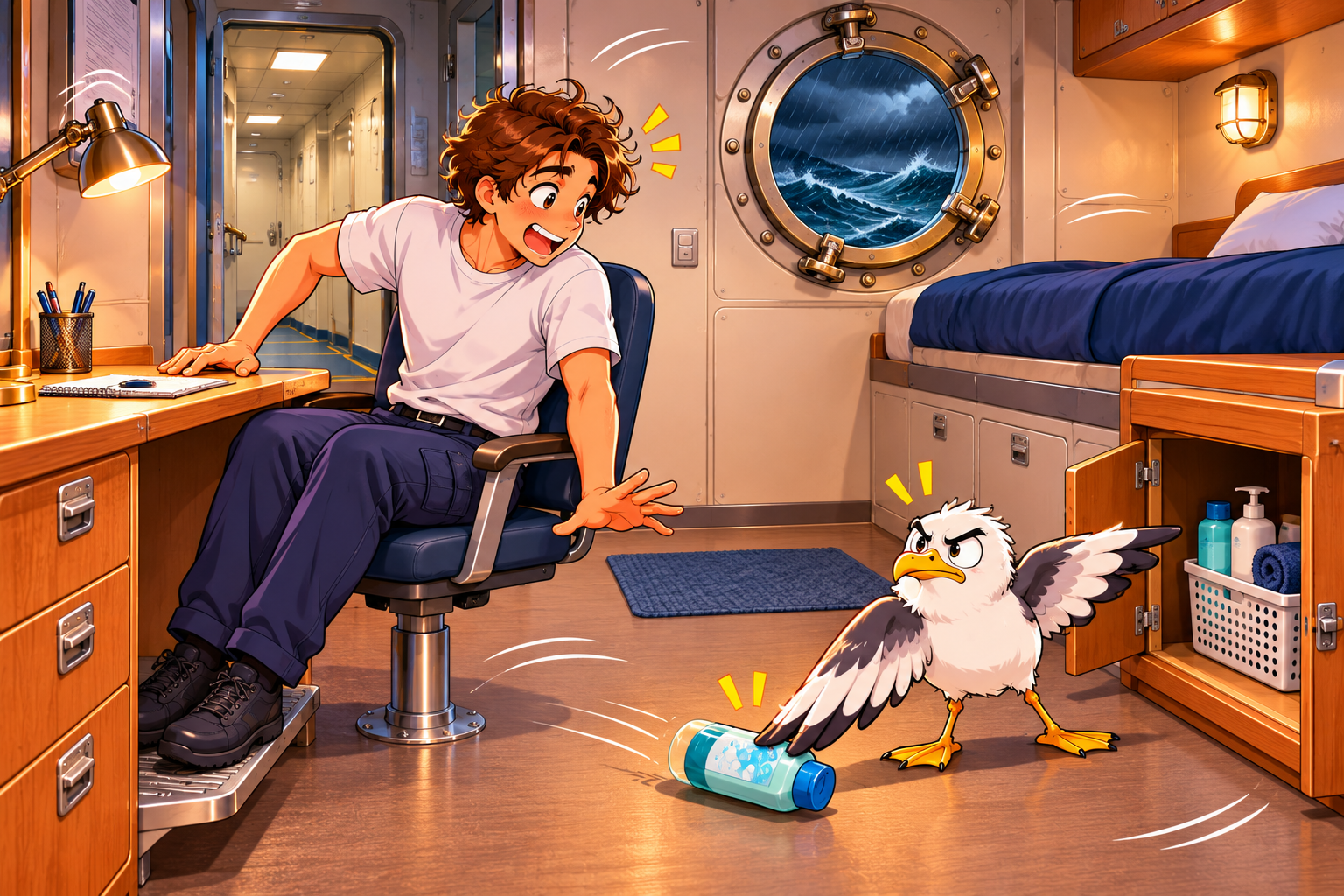
First Rough Weather? Your Shampoo Has Already Abandoned Its Position. 🌊😅
Yesterday, everything had a place. Today, your shower gel is exploring career opportunities under the desk.
You joined a ship. You knew ships move.
You understood this academically. There were diagrams.
What the diagrams failed to explain was the small negotiation involved in putting on trousers when the floor has developed its own opinions.
Welcome to your first rough weather at sea. 🌊
A bottle rolls across the cabin. Something rattles in a drawer. You discover that “I’ll put that away later” was apparently a time-sensitive statement.
Funny afterwards? Quite possibly.
Something worth preparing for? Absolutely.
This rough weather guide for cadets focuses on the everyday precautions that help protect you and the people around you on merchant ships: securing your cabin, moving carefully, adapting the work and speaking up early.
Different ship. Different motion. Same priority. 🚢
Ships do not all move in the same way. Conditions, loading, vessel design, speed and heading influence what you experience.
This article is a friendly introduction, not permission to improvise your own heavy-weather procedures.
Listen to your supervisor, follow the vessel’s safety management system and ask experienced crewmates what you need to do on this particular ship. You do not need to pretend that your first encounter with rough weather is your forty-seventh.
Prepare before the shampoo starts travelling 🧴
The best time to secure your cabin is while you can still walk across it without conducting a balance assessment.
When rough weather is expected, listen to announcements and instructions. Ask what preparation is required in your cabin and assigned work area.
Do not wait for the first serious roll to begin rescuing possessions from high shelves.
By then, the possessions may have started rescuing themselves.
Good heavy-weather preparation is also an everyday habit. Even when the forecast looks comfortable, store things with the understanding that you are living on a moving vessel.
The sea does not consult your desk layout before changing the afternoon.
Heavy things belong low. Your head lives underneath them. 📦
That large suitcase on top of the wardrobe? The heavy bag balanced on a high shelf? The solid object you placed overhead because it “fits perfectly”?
Fitting is not the same as being safely stowed.
Keep heavy belongings low down in suitable storage and secure them against movement. Do not use high shelves or the top of furniture as convenient parking for heavy objects.
A heavy item does not need to travel very far to cause an injury.
Use the fitted catches, retainers and approved securing arrangements. If a latch is damaged, report it. A drawer that opens itself is not an exciting cabin feature.
The cabin check: before things develop ambition 📋
- Heavy items: stored low, in suitable places, and secured against movement.
- Drawers and cupboards: properly closed, with their fitted catches engaged.
- Laptop, tablet and other valuables: safely stowed, rather than resting near an edge.
- Bottles, toiletries and cups: placed in suitable retained storage. Caps closed; breakable items protected.
- Suitcases, shoes and loose gear: stowed so they cannot slide into your path.
- Cables: kept clear of walkways and away from snagging or damage.
- Exit and access routes: clear, including the space needed to open the cabin door.
- Safety equipment: accessible in its designated location, with nothing piled over or in front of it.
Use the arrangements provided onboard. If something cannot be secured properly, ask. Creative furniture engineering is not a cadet competency.
Clean and tidy is also a safety measure 🧹
Remember our article about keeping your cabin clean and tidy?
This is another reason it matters.
A bag on the floor can become an obstacle. Loose belongings can slide into the doorway. A spill can turn a normal step into a very unwelcome experiment.
Housekeeping helps keep your footing, your access and your escape route clear.
A tidy cabin should also be a properly secured cabin. A beautifully arranged row of heavy objects on an open shelf is still a row of heavy objects waiting for an opportunity.
Think about where things could move, not just how attractive they look while the ship is steady.
For the everyday habits behind this, revisit our cabin hygiene and housekeeping guide for cadets.
The corridor has not become a race track 🚶
Move deliberately. Allow extra time. Use the fitted handrails and suitable handholds.
On stairs and ladders, follow the vessel’s safe access arrangements and maintain secure contact. Do not carry so much that you cannot hold on or see where you are stepping.
Your destination will still exist if you reach it a little more slowly.
Wear appropriate, secure-fitting footwear with suitable grip, in line with the ship’s requirements. A loose slipper is not a reliable colleague.
Watch for wet surfaces, changes in level and objects that may have shifted. Tell your supervisor about hazards rather than leaving them for the next person to discover.
Doors deserve attention too. Keep clear of closing edges and pinch points, use the provided handles and securing arrangements, and never defeat a self-closing fire door.
If you cannot move safely, stop somewhere safe and ask for assistance. There is no medal for completing the accommodation corridor while pretending to be completely unbothered.
The weather deck is not a viewing platform 📵🌊
The waves may look impressive through a properly closed window.
That does not mean you should go outside for a better angle.
Do not head onto exposed decks to watch the weather, take photographs or retrieve an item on your own initiative.
In conditions the master considers adverse, access is restricted. Work outside should be postponed where possible; any essential access must follow the vessel’s authorisation, risk assessment and protective arrangements.
As a cadet, follow the restrictions and remain under the assigned supervision. PPE does not turn an unauthorised trip outside into an acceptable one.
“I only need a minute” is not a risk assessment.
If something outside needs attention, report it. The bridge and responsible officers decide how it can be dealt with safely.
Likewise, do not open external doors or other closures simply to “have a look”. Follow the ship’s instructions for weather and watertight integrity.
Your phone can survive without that particular video. We would very much like you to do the same.
Work may change. Safety does not clock off. 🛠️
During heavy weather, routine exposed-deck jobs are normally postponed or restricted. The day’s work may shift towards suitable internal tasks, training or paperwork, where these can be carried out safely.
Your supervisor decides the arrangements. You do not need to invent a substitute job to demonstrate enthusiasm.
And being indoors does not make every task safe.
Handling heavy equipment, climbing, using sharp tools, carrying hot liquids or working near moving machinery can become more hazardous as the vessel moves.
Even a simple cleaning job needs thought. Is the floor already difficult to walk on? Will the equipment stay put? Could the work create another hazard?
If the movement makes the task unsafe, stop and inform your supervisor. Changed conditions may require the work to be reassessed, postponed or carried out differently.
Our toolbox talks and routine jobs guide explains why asking questions and speaking up belong in ordinary work, too.
Deck cadets: the weather is part of the watch 🚢
If you are assigned to the bridge, allow enough time to get there safely and follow the officer of the watch’s instructions.
Stay attentive to your assigned duties. Ask where you should position yourself and which handholds or supports are suitable.
Observe how the bridge team monitors conditions and communicates changes. Save longer questions for an appropriate moment, without distracting the watch.
You are there to learn and contribute. Filming a rolling coffee cup for your friends is unlikely to appear on the officer’s priority list.
If you feel unwell, unsteady or unable to carry out a task safely, say so promptly.
Do not disappear to your cabin without informing the responsible officer. The bridge team needs to know who is available and whether someone needs help.
Engine cadets: indoors does not mean motion-free ⚙️
The machinery spaces move with the rest of the ship. Ladders, platforms, hot surfaces and heavy equipment deserve extra care.
Follow your supervising engineer’s instructions about rounds, routes and tasks. Use suitable handholds and keep clear of machinery, hot pipework and other hazards.
A pipe that happens to be nearby is not automatically a handrail.
If you notice loose tools, unsecured stores, a leak or something that has shifted, report it. Do not attempt to restrain moving heavy equipment by yourself.
Your job is to help the team safely, not to become the person who tried to tackle a spare part.
If your stomach submits a formal complaint… 🤢
Seasickness can happen. Feeling unwell does not mean you are weak, unsuitable for the profession or required to apologise to the entire engine department.
Tell your supervisor early and follow the advice of the person responsible for medical care onboard.
Small sips of water and lighter meals may be easier to manage. If you cannot keep fluids down, feel faint or become significantly unwell, report it promptly so you can be assessed.
Do not borrow somebody else’s tablets or casually experiment with medicines before a watch. Some motion-sickness treatments cause drowsiness or affect alertness.
Get appropriate advice about what is suitable for you and your duties, and tell the responsible person what you have taken.
Also, if reading your phone makes you feel worse, put it down. The group chat can continue without a live broadcast from your stomach.
“I feel unwell” and “I do not feel safe doing this” are useful information.
Your supervisor can respond to what you report. They cannot reliably respond to what you are silently trying to endure.
Dinner is still dinner. Carry it with a little respect. 🍲
Follow any revised meal arrangements. The galley team may need to adapt what is prepared or how it is served.
Be patient. Cooking while the ship moves is already a demanding job without someone requesting an elaborate off-menu performance.
Avoid carrying several dishes or hot drinks when you cannot keep a secure hold. Ask for help or use the arrangements provided onboard.
Keep cups and dishes in the retained positions provided, and clean up or report spills as soon as it is safe to do so.
After eating, return your items properly. A forgotten cup can become someone else’s problem surprisingly quickly.
Something is loose. Must you catch it? Usually, no. ✋
A rolling lightweight bottle is one thing. A heavy object moving with the ship is another.
Do not put your body in the path of a moving load or try to catch falling equipment. Keep clear, warn people nearby and inform the responsible officer.
If securing something now would expose you to danger, stop. Ask for assistance and a safe plan.
Report damaged catches, shifted items, water ingress and anything else that needs attention. If someone is injured or there is an immediate emergency, raise the alarm and follow the vessel’s procedures.
Your laptop may be expensive. Your fingers remain considerably harder to replace.
When it settles down, do not immediately unpack the chaos 😌
Conditions can change again. Keep sensible securing habits in place and follow instructions about when restricted areas or activities may resume.
When it is safe, check for shifted belongings, spills or damage in your cabin and assigned area. Open cupboards carefully: something inside may now be resting against the door.
Tell your supervisor about any defects or near misses. A simple lesson from this passage can prevent an injury on the next one.
And if you discovered that a particular shelf is a terrible place for your belongings, believe the evidence.
The shampoo has completed the trial. No further testing is necessary.
Keep your records organised. Keep your devices secured. 📂
Wave — The Seafarers’ Digital Wallet helps you organise personal document copies, monitor certificate expiry dates and keep track of your sea service.
Sort out your records when conditions and your duties allow. During rough weather, your phone or tablet belongs safely stowed whenever you are not using it.
Keep required originals protected too, without obstructing access to safety equipment or your exit.
Respect the weather. Secure the cabin. Keep yourself safe. 🌊
You do not need to impress anyone by pretending the movement does not affect you. Prepare early, follow instructions, move carefully and speak up when something is wrong.
The aim is simple: everyone finishes the voyage as safely as they started it.
Your first rough weather may eventually become a funny story.
Ideally, the only person abandoning their position in that story will be a bottle of shampoo. 😅
What was the first thing you learned to secure properly at sea? Share a useful lesson or a funny memory without identifying other people or revealing sensitive ship information.
General guidance for merchant ship cadets, with hypothetical humorous situations. Follow your vessel’s safety management system, risk assessments and officers’ instructions. Further reading: MCA Code of Safe Working Practices; Norwegian Maritime Authority rough-weather lessons; Together in Safety heavy-weather guidance; and NHS motion-sickness information.
Good stories travel. Useful tips should too. 🤝
Enjoyed the article? Share it with a shipmate — and tell your friends about Wave.
Leave a Reply